ERP Security and Segregation of Duties in the Age of AI Agents
Lack of internal controls is the top weakness behind occupational fraud. As AI agents start acting inside ERP, the security model you design today becomes their guardrail.
ERP security used to be a compliance topic that came up once a year, when the auditors arrived. Two things have changed that. Breaches have become more expensive, and AI agents are starting to read and act on ERP data on users' behalf.
In Dynamics 365, an agent works with the permissions of the identity it runs under. That means your role design, and your segregation of duties (SoD), is now the guardrail for both people and agents.
Why access control is the first line of defense
The Association of Certified Fraud Examiners' 2024 Report to the Nations found:
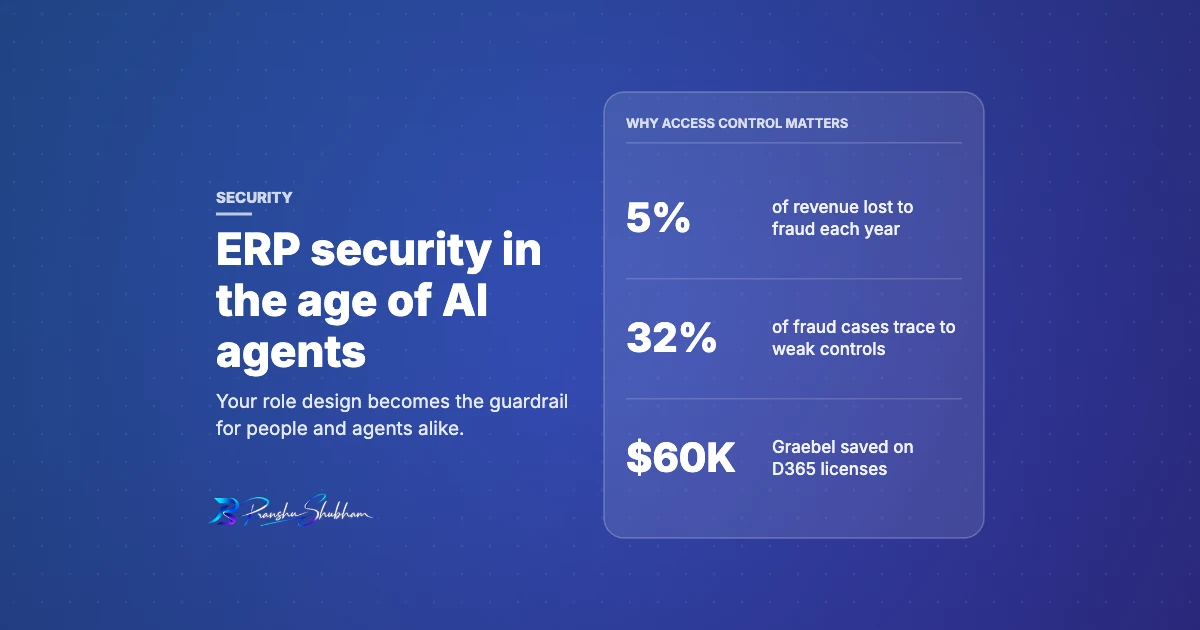
- Organizations lose an estimated 5% of revenue to fraud each year
- The median loss per case is $145,000
- A lack of internal controls was the primary weakness in 32% of cases, and override of existing controls in a further 19%
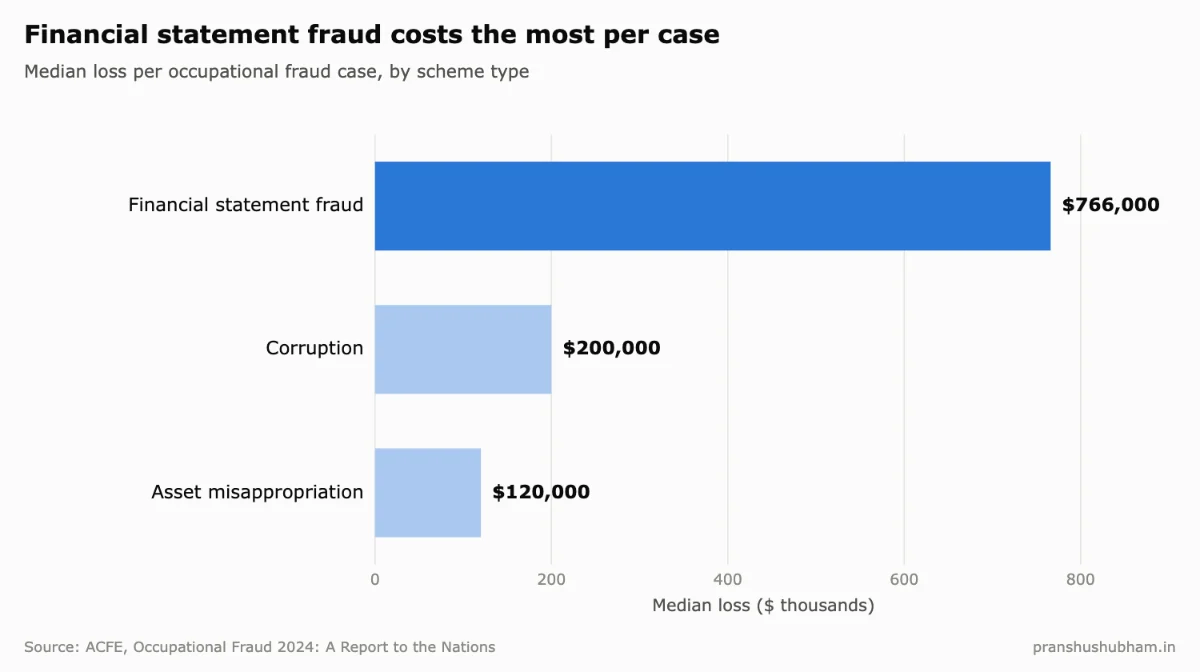
The losses vary sharply by scheme. Median losses reach $766,000 for financial statement fraud, against $200,000 for corruption and $120,000 for asset misappropriation.
Breaches tell the same story. IBM's 2025 Cost of a Data Breach report put the global average cost at $4.44 million, and found that 97% of organizations that suffered an AI-related security incident lacked proper AI access controls. Coverage of IBM's 2026 edition reports that the global average rose to $4.99 million. Verizon's 2025 Data Breach Investigations Report found that breaches involving a third party doubled, from 15% to 30%.
Case study: Graebel cleans up D365 access
Graebel, a talent mobility company supporting clients in 165 countries, ran Dynamics 365 Finance & Operations with familiar problems: too many licensed users, users with more access than they needed, no formal process for SoD conflicts, and weak native audit reporting.
The company implemented Delinea's Fastpath Access Control and Security Designer on top of D365 F&O. According to the vendor's published case study, Graebel:
- Saved $60,000 in D365 licensing costs by right-sizing access
- Reduced security tasks that once took months to just minutes
The security and cost benefits came from the same exercise. Users with more access than they need often also need a more expensive license.
What changes when AI agents arrive
Microsoft's Dynamics 365 ERP MCP server, which lets AI agents work with finance and operations data, follows a clear principle: every request runs under an authenticated identity, finance and operations security roles apply to every call, and the server never elevates privilege.
That's good design, but it puts more weight on your role model. If a user's role grants more than they need, an agent acting for that user gets more than it needs too. Autonomous agents have their own identities, which need roles designed with the same care.
A practical SoD checklist for D365
- Map your SoD rules. Start with the classic conflicts: create vendor and pay vendor; create purchase order and approve invoice; post journals and approve them.
- Use D365's segregation of duties rules to flag conflicting duties when roles are assigned.
- Design roles by job, not by person. Build from standard duties and privileges, and avoid cloning a senior user's access.
- Review access quarterly. Remove roles that people no longer need, especially after job changes.
- Right-size licenses at the same time. Over-access and over-licensing usually go together.
- Give every agent a named owner and its own role. Treat autonomous agents as users with job descriptions.
- Log and review sensitive actions. Vendor bank changes and journal postings deserve alerts.
Frequently asked questions
Do AI agents bypass Dynamics 365 security? Not with Microsoft's ERP MCP server, according to Microsoft Learn: requests run as an authenticated identity, and the same roles, duties, privileges and data policies apply. That's why role design matters so much.
What is segregation of duties in ERP? It's the principle that no single person should control every step of a sensitive process, such as creating a vendor and paying it, so that errors and fraud are caught by someone else.
The takeaway
Strong ERP security used to be about passing the audit. Now it's also the boundary that keeps AI agents safe. Clean up roles and SoD first, and your agent program inherits that discipline for free.
I'm Pranshu Shubham, a D365 F&O Solution Architect. If you're reviewing D365 security ahead of an AI rollout, get in touch.
Keep learning on this site
- D365 security role design and SoD matrix (free template)
- Security roles and segregation of duties in D365 (video lesson)
- Building AI agents for Dynamics 365 with MCP
- Build an AI Agent for Dynamics 365 with MCP (workshop)