Predictive Maintenance in Dynamics 365: Lessons from 312,500 Assets at Enerjisa Üretim
Unplanned downtime costs the world's largest companies about 11% of revenue. Here's how one energy producer laid the foundation for predictive maintenance on Dynamics 365.
Every plant manager knows the feeling: a critical machine fails without warning, a line stops, and the maintenance team spends the night firefighting. It's expensive. Siemens' True Cost of Downtime 2024 report estimates that Fortune Global 500 companies lose almost $1.4 trillion a year to unplanned downtime, equivalent to 11% of their revenues. In a large automotive plant, an hour of downtime now costs around $2.3 million.
Predictive maintenance promises to change that. But the real story, as one Turkish power producer shows, starts long before any sensor or algorithm.
What predictive maintenance actually delivers
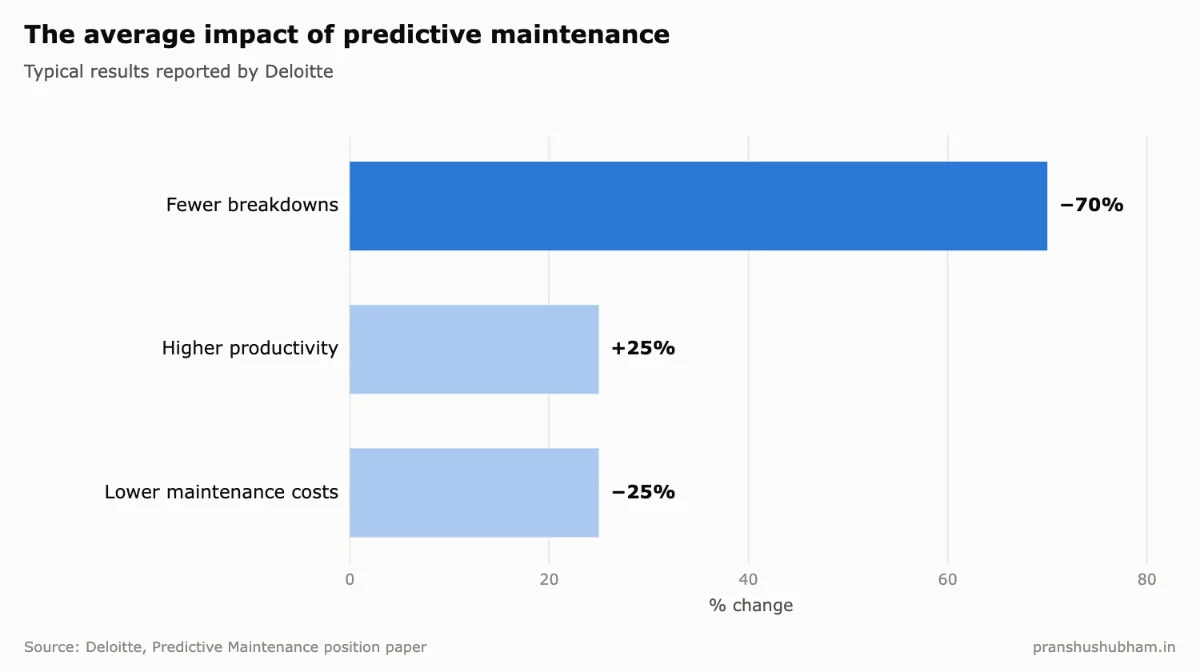
Predictive maintenance uses equipment data, such as vibration, temperature or run hours, to fix assets just before they fail rather than on a fixed calendar or after a breakdown. According to Deloitte's position paper on predictive maintenance, it typically:
- Increases productivity by 25%
- Reduces breakdowns by 70%
- Lowers maintenance costs by 25%
- Raises equipment uptime by 10 to 20% and cuts maintenance planning time by 20 to 50%
Those are averages, not promises. The organizations that get close to them have one thing in common: clean, digital asset data to build on.
Case study: Enerjisa Üretim digitizes 312,500 assets
Enerjisa Üretim runs 29 power plants in Türkiye. Its legacy maintenance system was heavily customized, field workers had no mobile app, and much of the equipment data still lived on paper. There was no single platform covering an asset's whole life cycle.
The company moved to the Asset Management capabilities of Dynamics 365 Supply Chain Management, with digital twins on Azure and IoT-based condition monitoring. According to Microsoft's published customer story:
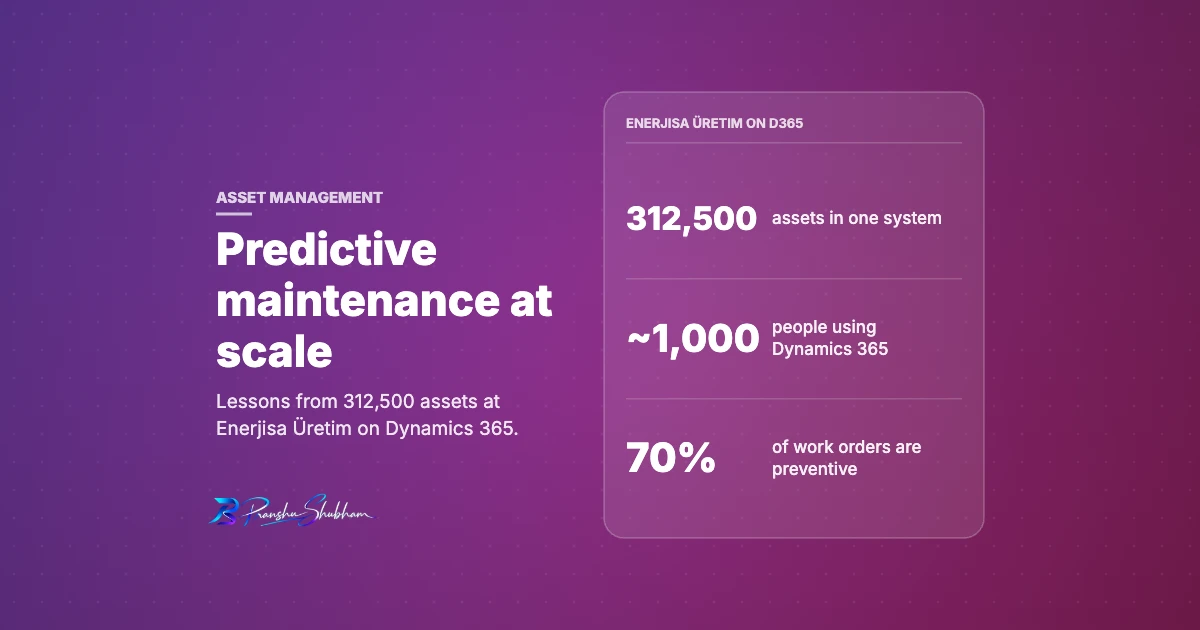
- All 312,500 assets were managed in the new system by the end of 2024
- Almost 1,000 people now use Dynamics 365
- Some plants handle up to 130 work orders a day, and about 70% of work orders are preventive
- Paper output fell by 70%, saving about $50,000 in printing
Notice what Enerjisa did first. Before predicting anything, it put every asset, every work order and every technician on one digital platform. Most of its work orders are already preventive rather than reactive. That's the foundation predictive maintenance needs.
Five lessons for your own program
1. Digitize the asset register before you buy sensors. Predictive models are only as good as the asset hierarchy, functional locations and maintenance history behind them. If technicians still record work on paper, start there.
2. Get preventive maintenance right first. Calendar- and counter-based maintenance plans in D365 Asset Management are the stepping stone. Enerjisa's 70% preventive share shows a mature base.
3. Connect machine data to maintenance counters. Dynamics 365's Sensor Data Intelligence feature (currently in preview, according to Microsoft Learn) can collect machine data to update asset counters and drive predictive maintenance. Plan it as a pilot on your most critical assets.
4. Put a mobile app in technicians' hands. Real-time work order updates from the field are what make the data trustworthy.
5. Measure downtime, not just maintenance cost. The biggest prize is production you don't lose. Track unplanned downtime hours per month alongside maintenance spend. Siemens found that an average large plant still loses 27 hours a month to unplanned downtime.
How to start in 90 days
- Pick one plant and its 20 most critical assets.
- Clean up the asset hierarchy, functional locations and spare-part links in D365.
- Move those assets onto counter-based maintenance plans.
- Pilot sensor data on two or three assets with a clear failure mode.
- Report downtime hours before and after.
Frequently asked questions
Does Dynamics 365 support predictive maintenance out of the box? D365 Supply Chain Management includes Asset Management for preventive and condition-based maintenance. The IoT-based Sensor Data Intelligence feature that drives predictive scenarios is in preview, so check its current status on Microsoft Learn before planning production use.
What data do I need for predictive maintenance? A complete asset register, a reliable work order history, and at least one machine signal (such as run hours, temperature or vibration) linked to each critical asset.
The takeaway
Predictive maintenance isn't a sensor project. It's an asset data project that ends with sensors. Enerjisa Üretim shows what that foundation looks like at scale.
I'm Pranshu Shubham, a Dynamics 365 F&O Solution Architect. If you're planning an asset management or predictive maintenance program on D365, get in touch.
Keep learning on this site
- Agentic ERP: AI agents in Dynamics 365 Supply Chain
- Dynamics 365 F&O data migration checklist
- Data migration plan and field mapping workbook (free template)
- Dynamics 365 Supply Chain Management Deep Dive (course)