One Global D365 Template, 60+ Countries: What Hellmann's Rollout Teaches Us
Two countries live per month, 99% of the template intact. What it takes to roll one Dynamics 365 design out across 100+ legal entities without it falling apart.
A global template sounds simple: design the ERP once, then roll it out country by country. In practice, every country team has a reason why its processes are special, and a template that bends for each of them stops being a template.
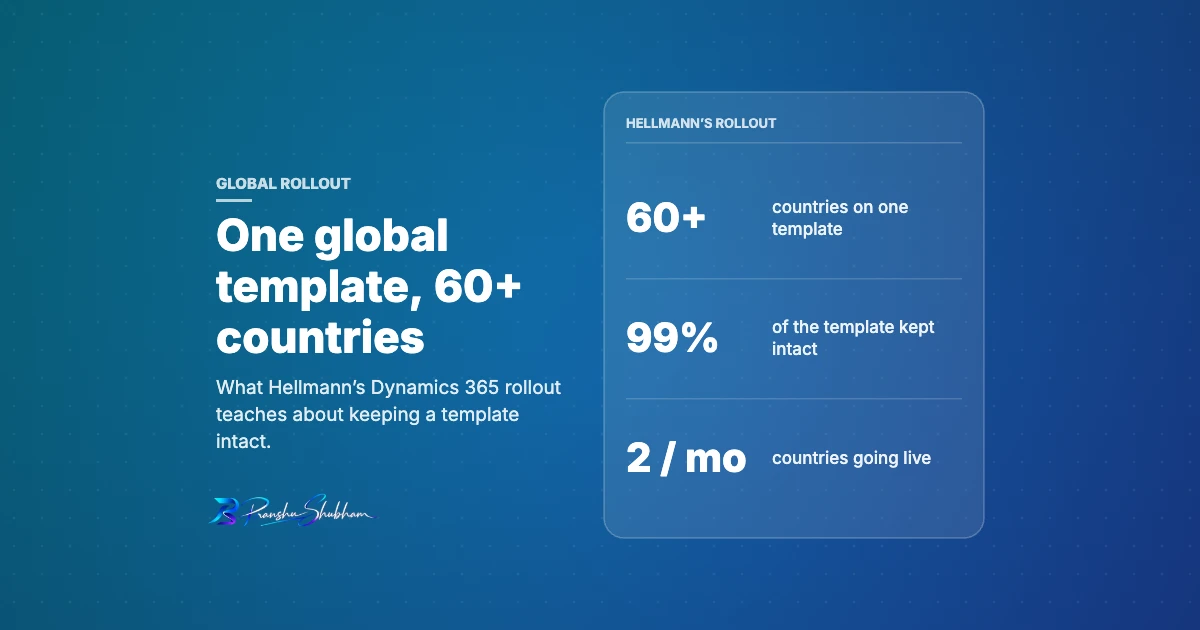
That's why a statistic from Hellmann Worldwide Logistics stands out: after rolling Dynamics 365 Finance out across more than 60 countries, 99% of the solution model was still intact.
Why global rollouts are hard
Gartner predicts that by 2027, more than 70% of recently implemented ERP initiatives will fail to fully meet their original business goals. Prosci's 2025 research defines ERP failure as delivering under 70% of expected benefits, and finds it happens between 11% and 31% of the time. Panorama Consulting's 2026 ERP report found that more than a quarter of organizations exceeded their project budgets.
Multi-country programs multiply the risk. Every country adds local tax, statutory reporting, languages and a new group of users who weren't in the original design workshops. Microsoft's own implementation guide notes that a single global deployment is the most common approach, but warns that "poor adoption is possible in regions where users aren't engaged."
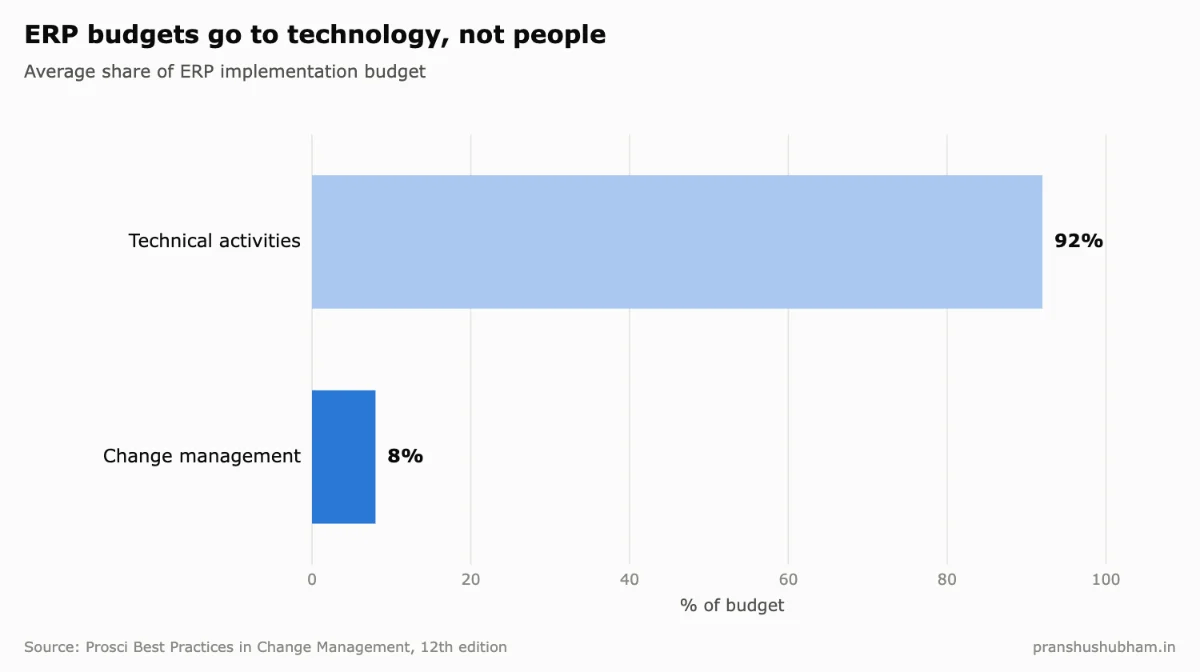
And yet budgets rarely reflect that people risk. Prosci finds organizations spend 92% of their ERP implementation budget on technical activities and only 8% on change management.
Case study: Hellmann's "golden template"
Hellmann Worldwide Logistics, a German logistics company based in Osnabrück, needed to replace end-of-life finance software and bring standardization, compliance and global transparency to its finance operations.
With partner HSO, Hellmann built a "golden template" on Dynamics 365 Finance and rolled it out country by country across 60+ countries and 100+ legal entities. According to HSO's published case study:
- 99% of the solution model remained intact by the end
- Rollouts reached a pace of two countries going live per month
- Hellmann can now scale to twice its size, handling double the transactions, with the same resources
- Template changes were limited mainly to stricter statutory reporting in some countries
- Delivery started with HSO and then moved to Hellmann's internal teams
A second example: Adecco
The Adecco Group, based in Switzerland, uses a Dynamics 365 Finance template approach across an organization of 450 legal entities in 60 countries and territories. In Microsoft's published story, Adecco reports $540,000 in savings over three years, a financial close in Japan shortened by two days, and shared service centers that have absorbed more than 50% of local financial activities.
Six lessons for your global template
1. Design the template for the group, not the pilot country. Bring two or three representative countries into design so the template isn't shaped by one market's habits.
2. Separate global from local by rule. Agree upfront what's global (chart of accounts, core processes, master data) and what's local (tax, statutory reports, language). Microsoft is clear that you can't combine multiple countries in a single legal entity, so plan the legal entity structure early.
3. Protect the template with design authority. Every local change request goes to one group. Hellmann's 99% figure didn't happen by accident.
4. Industrialize the rollout. A repeatable country kit, with data migration templates, test scripts, training and cutover plans, is what makes two go-lives a month possible.
5. Build internal capability. Hellmann's handover from partner to internal teams is the long-term win. Plan knowledge transfer from wave one.
6. Engage each country early. The adoption risk Microsoft warns about is real. Give every country a local champion months before go-live.
Frequently asked questions
What is a global template in ERP? It's one standard ERP design (processes, configuration, master data and reports) that's rolled out to every country or business unit, with only legally required local changes.
How long does a global D365 rollout take? It depends on scope, but once a template is stable, mature programs can go live in several countries per quarter. Hellmann reached two countries per month.
The takeaway
A global template succeeds through discipline, not technology: clear rules on what can change, one design authority, and a repeatable country kit. Get those right and Dynamics 365 can scale with you, country by country.
I'm Pranshu Shubham, a D365 F&O Solution Architect who has delivered rollouts across four regions. If you're planning a multi-country D365 program, get in touch.
Keep learning on this site
- Statement of work (SOW) template and example for IT projects
- Business process catalog L1–L4 (free template)
- Fit-gap analysis in Dynamics 365: a practical guide
- ERP implementation playbook: business case to hypercare (free e-book)
- ERP Implementation Playbook: Discovery to Hypercare (course)
Sources
- HSO, Hellmann's global finance transformation
- Microsoft customer story, The Adecco Group
- Microsoft Learn, Global deployment scenarios
- Microsoft Learn, Define your organizational strategy
- Gartner, Avoid disappointing ERP initiatives
- Prosci, Why do ERP implementations fail? (2025)
- Panorama Consulting Group, 2026 ERP Report