ESG Reporting from ERP Data: Why CSRD Is Really a Data Project
Sustainability reporting is moving from spreadsheets to systems. The data you need for CSRD already sits in your ERP. Here's how leading companies are using it.
For most companies, sustainability reporting started as a spreadsheet exercise: collect energy bills, estimate travel emissions, write a report once a year. Regulation is changing that, and so is the size of the numbers.
According to CDP's 2024 analysis, companies' Scope 3 supply chain emissions are on average 26 times greater than their emissions from direct operations. Yet only 15% of companies have set a Scope 3 target. Those emissions live in purchasing, logistics and product data, which means they live in your ERP.
Where CSRD stands now
The EU's Corporate Sustainability Reporting Directive (CSRD) has been narrowed. Under the Omnibus I agreement, endorsed by the European Parliament in December 2025, it applies to companies with more than 1,000 employees and net turnover above €450 million, for financial years on or after 1 January 2027, according to PwC's summary.
The scope is smaller, but the companies still in it face detailed, auditable reporting, and many outside it face the same questions from customers, lenders and investors.
What the leaders do differently
PwC's 2025 Global Sustainability Reporting Survey of 496 executives in 40 countries found that 41% were planning to report under the CSRD. More than half now use central sustainability data storage, carbon calculation and disclosure management tools, and use of AI for sustainability reporting almost tripled to 28%, from 11% a year earlier.
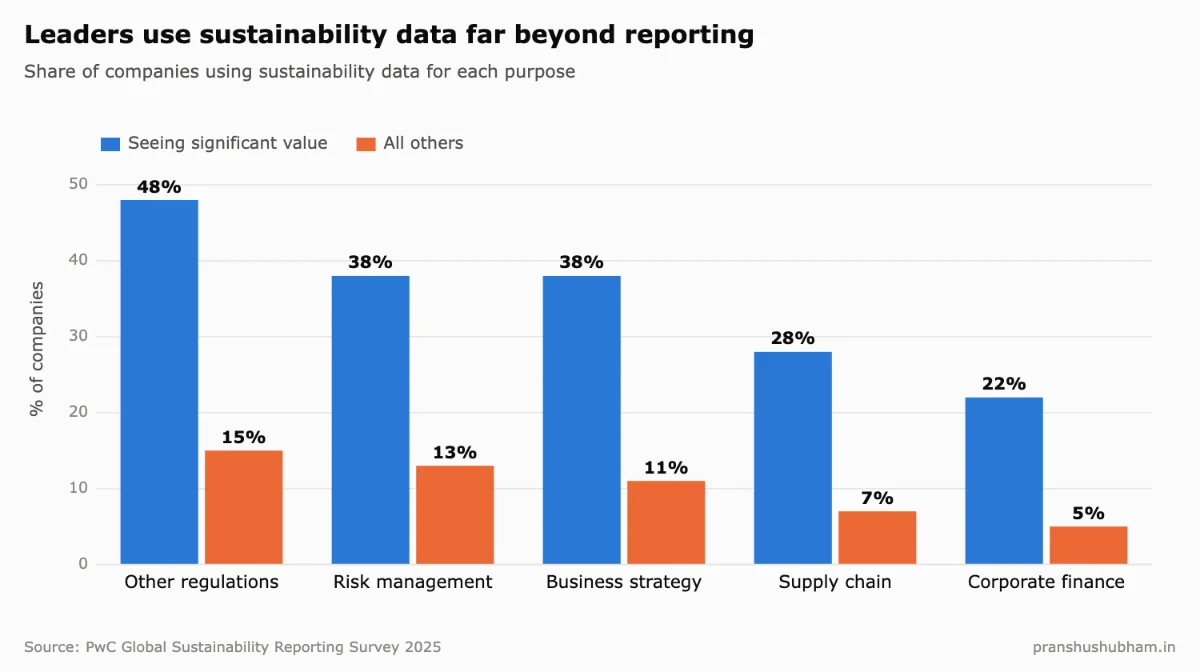
The biggest difference is in what companies do with the data. Companies that see significant value from sustainability data are far more likely to use it beyond reporting:
| Use of sustainability data | Companies seeing significant value | All others |
|---|---|---|
| Compliance with other regulations | 48% | 15% |
| Risk management | 38% | 13% |
| Business strategy | 38% | 11% |
| Supply chain transformation | 28% | 7% |
| Corporate finance | 22% | 5% |
Case study: Fellowmind's customers in Finland and the Netherlands
Microsoft partner Fellowmind works with manufacturers that need to combine emissions data with business data to meet CSRD. It uses Microsoft Cloud for Sustainability and Sustainability Manager, together with its Footprint 365 solution, which calculates emissions in real time and links each one back to the activity that caused it.
Two of the customers in Microsoft's published story:
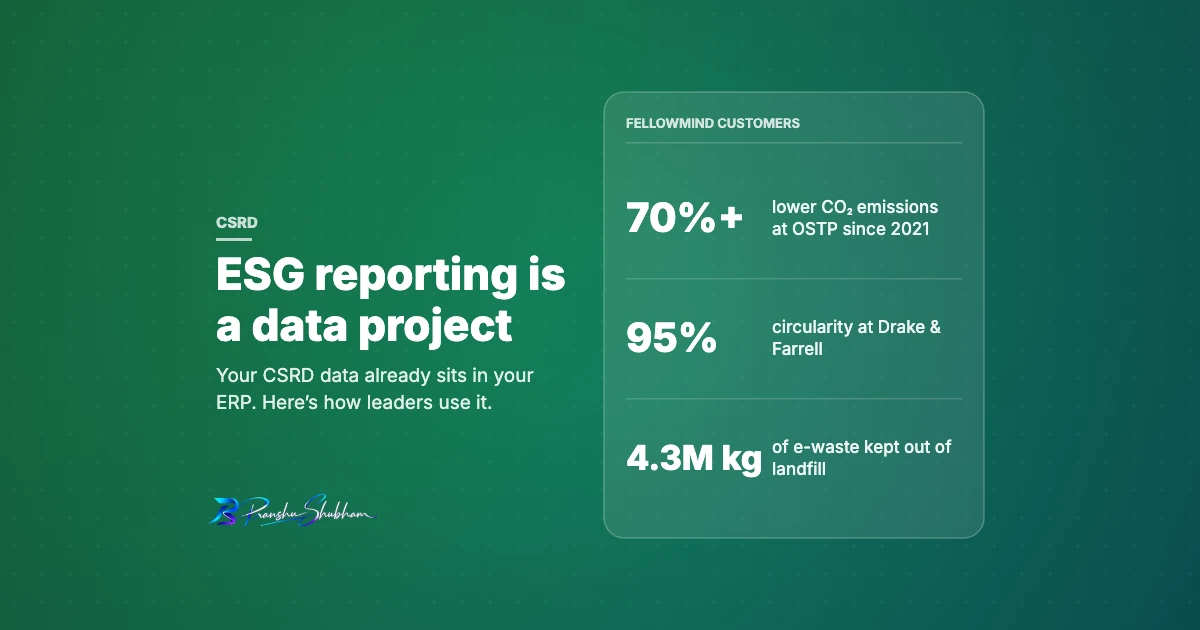
- OSTP, a stainless steel tube manufacturer, connected its data platform to Microsoft Cloud for Sustainability and has reduced CO2 emissions by over 70% since 2021.
- Drake & Farrell, an electronics refurbisher running Dynamics 365 Finance, processes 1.5 million electronic devices a year with 95% circularity, and has kept 4.3 million kilograms of e-waste out of landfill.
Five steps to ERP-based ESG reporting
1. Map each disclosure to its source data. Purchase spend, freight, energy invoices and production volumes are already in D365. Decide which fields feed which emission category.
2. Clean the data at the source. Supplier categories, product weights and units of measure drive emissions factors. Fix them in the ERP.
3. Use activity data where possible. Spend-based estimates are a starting point; quantity-based data (kilograms, kilowatt-hours, kilometers) is more accurate.
4. Keep an audit trail. CSRD reports will be assured. Every number should trace back to a transaction, as Footprint 365 does.
5. Use the data for decisions. Add emissions to supplier evaluation and product costing, not just the annual report.
Frequently asked questions
Who has to report under CSRD now? Under the Omnibus I changes summarized by PwC, CSRD applies to EU companies with more than 1,000 employees and net turnover above €450 million, from financial years starting on or after 1 January 2027. Check the final rules for your situation.
Can Dynamics 365 calculate emissions? Microsoft Sustainability Manager, part of Microsoft Cloud for Sustainability, calculates emissions and can use data from Dynamics 365 and other sources.
The takeaway
CSRD looks like a reporting problem, but it's really a data problem, and most of the data is already in your ERP. Companies that connect the two get more than compliance: they get a new lens on cost, risk and suppliers.
I'm Pranshu Shubham, a D365 F&O Solution Architect. If you're planning ESG reporting from your Dynamics 365 data, get in touch.
Keep learning on this site
- ERP analytics with Microsoft Fabric: the Superbet case study
- Data entities and the Data management framework (video lesson)
- Dynamics 365 F&O integration patterns guide (free e-book)
- AI Transformation for Business Leaders (course)