From Mechanical Engineer to ERP Solution Architect: My Career Journey
From a cement plant floor to leading Dynamics 365 programs across four regions: the turns my career took, and what engineers and career switchers can take from them.
People often ask how a mechanical engineer ends up designing ERP solutions for retailers in the USA and agri-science companies across three continents. The honest answer: one step at a time, and each step used what the last one taught me.
If you are an engineer, a plant professional or anyone thinking of switching into ERP and consulting, this is my story and the lessons I would pass on.
Starting on the plant floor
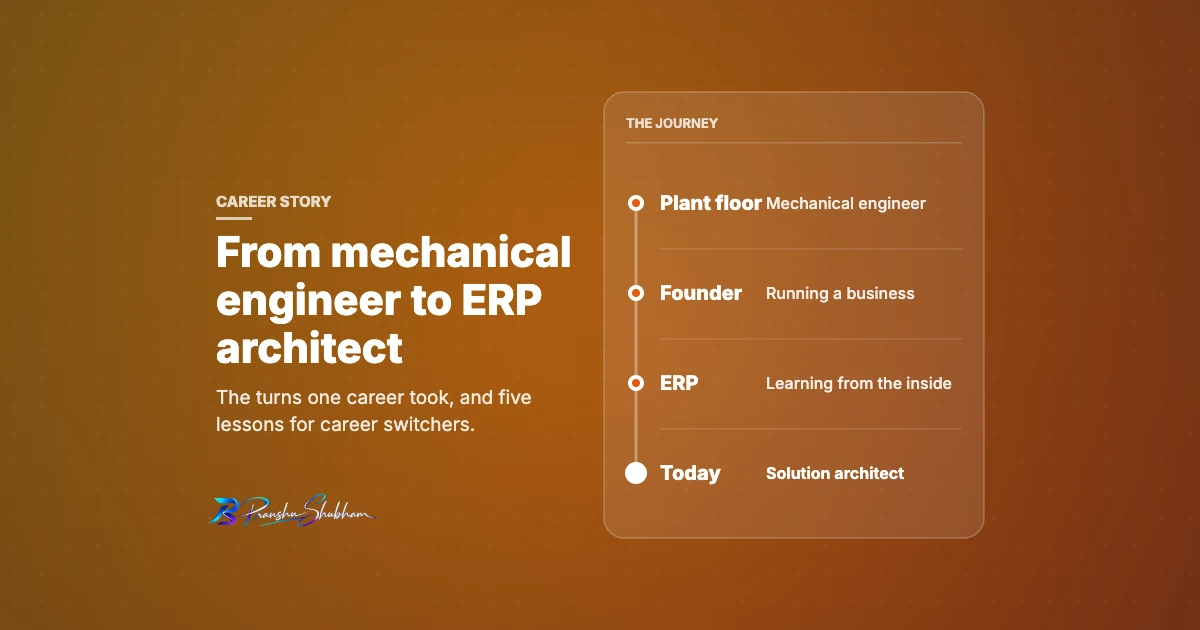
I graduated in Mechanical Engineering from Heritage Institute of Technology and joined Star Cement as an Assistant Mechanical Engineer. The work was physical and measurable. I managed sectional inventory, vendors and production control for cement mill operations.
The defining project there was an energy conservation program. I led a 60-member cross-functional team, and we won the Star Cement Energy Conservation Summit Award. We reduced section operating costs by 10% and achieved a zero-breakdown production target through structured maintenance and resource planning.
Lesson: engineering teaches systems thinking. A plant is a set of connected processes, and a small failure in one place shows up as cost somewhere else. ERP is the same idea, applied to a whole business.
Becoming a founder
In 2020, during a period of real market disruption, I founded pran4you, a registered business consultancy. We advised more than 10 SME and MSME clients on digital transformation, ERP and CRM decisions, process automation and go-to-market strategy. The Government of Bihar recognised pran4you with the Best Entrepreneur Award in the MSME Consulting category.
Lesson: running a business teaches you the client's side of the table. You learn what it feels like to pay for technology and wait for value. I still bring that view into every ERP program.
Learning ERP from the inside
Next, I joined Sears Global Technology as an Operations Advisor on Dynamics 365 Finance and Operations. I ran order-to-cash and procure-to-pay cycles, sourcing more than 300 parts and creating purchase orders every week.
Lesson: using the system every day, under volume, is the best training a future consultant can get. You learn which screens users trust, which steps they skip and why.
Leading transformation
At DynaTech Systems, I moved into business transformation and solution leadership. Since then I have worked across 7 to 10 Dynamics 365 implementations in retail, agri-chemical, steel, environmental science and FMCG, across the USA, EMEA, APAC and LATAM. That includes a multi-stream US retail program with more than 12 third-party integrations and more than 40 functional design documents, and a four-region global rollout.
Alongside delivery, I built Docupilot, an enterprise RAG AI platform that cut consultant onboarding time by about 60%, and designed MCP-based AI agents on Dynamics 365. I was invited to speak about AI-enabled supply chain transformation at Microsoft Copilot Summit in San Diego.
Never stop learning
Each stage pushed me to learn something new. I completed an Executive MBA in Supply Chain and Strategy at IIM Kashipur while working full time, earned my PMP and Microsoft certifications, and studied Generative AI at IIT Patna. Each one filled a gap I had felt on real projects.
Five lessons for career switchers
- Your domain knowledge is your edge. Engineers understand operations; accountants understand finance. Lead with it.
- Learn the process before the product. Systems change; how businesses make, move and sell things changes slowly.
- Get close to real users. Support, operations or key-user roles are valid entry points into consulting.
- Stack credentials with purpose. Pick each certification or degree to close a gap you have actually seen.
- Share what you learn. Writing and speaking build trust faster than any CV.
Frequently asked questions
Can a mechanical engineer become an ERP consultant? Yes. Supply chain, manufacturing, warehouse and asset management modules suit engineers especially well.
Do I need an MBA? Not to start. It helped me later, when conversations moved to strategy, business cases and executives.
Let's talk about your path
If you are planning a similar move, my 1:1 Career and Consulting Mentorship and the Freshers to ERP Consultant course can help. You can read more about the projects mentioned here on my Work page.