ERP Change Management: Why People, Not Technology, Decide Your D365 Go-Live
Most ERP budgets go to technology, yet human factors matter six times more for benefits. A look at the data, and at how Lifetime Products built a team to make D365 stick.
Ask a project team why an ERP go-live went badly and you'll hear about integrations, data and performance. Ask the users and you'll hear something else: "Nobody told us it was changing," or "The new screens don't match how we work."
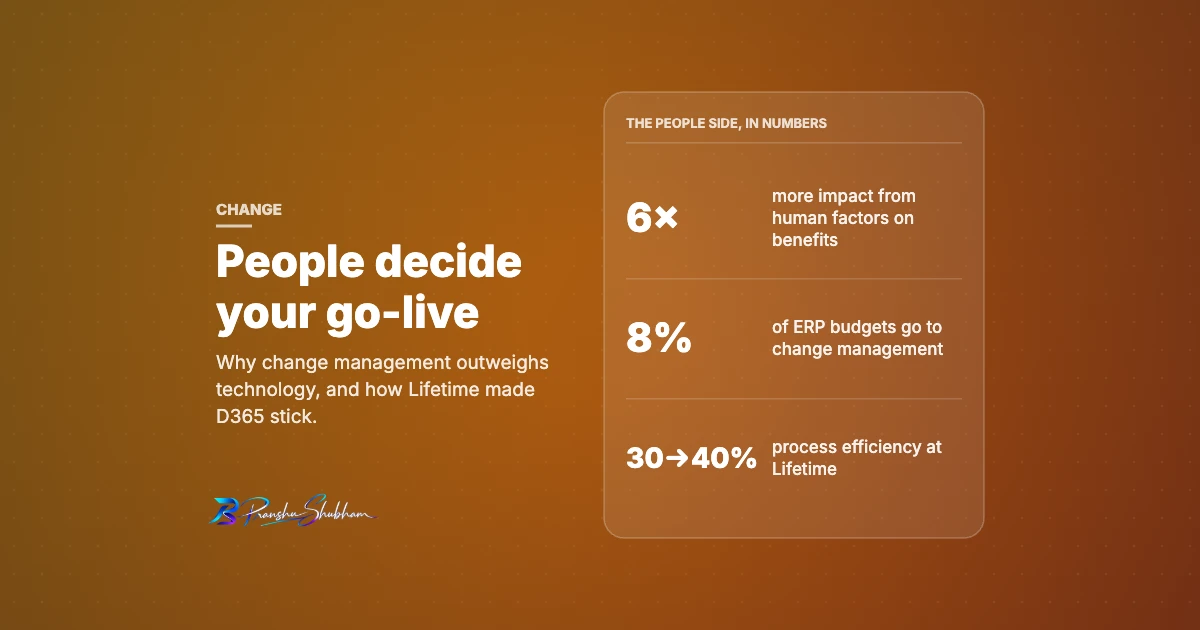
The data backs the users. According to Prosci's research, human factors matter six times more than technical factors in improving ERP benefits. Yet organizations spend an average of 92% of their ERP implementation budget on technical activities and just 8% on change management.
The numbers behind the people side
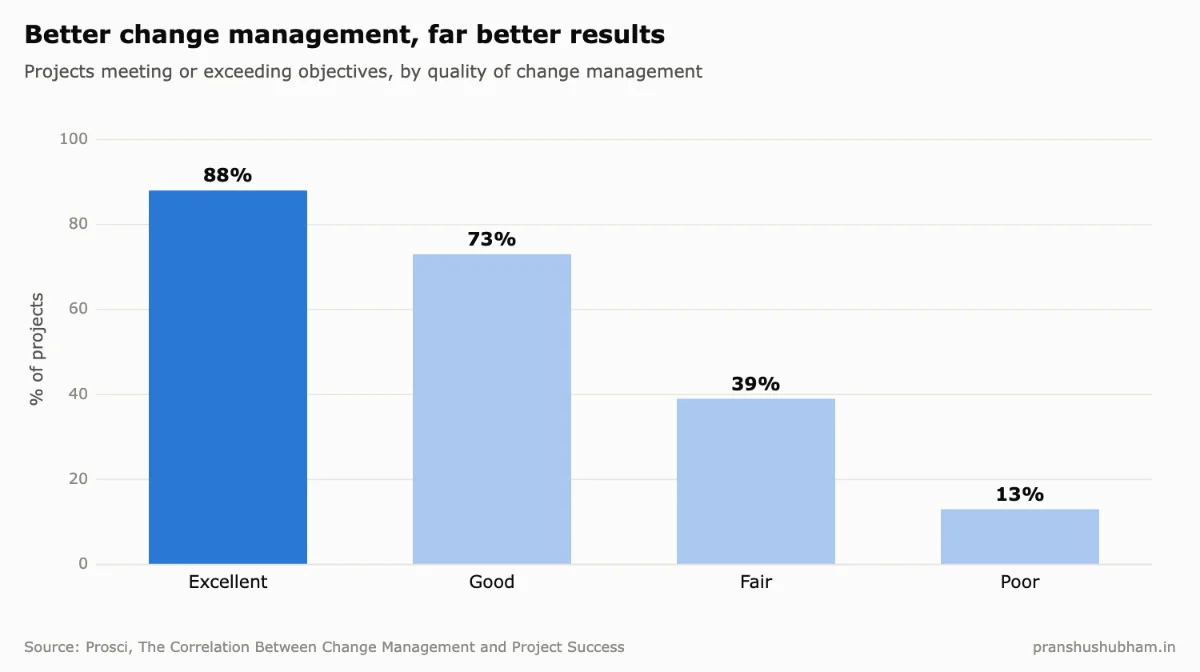
Prosci's long-running research, drawing on more than 2,600 change practitioners, shows a direct link between change management quality and project success:
- 88% of projects with excellent change management met or exceeded objectives
- 73% with good change management did so
- 39% with fair change management did so
- Only 13% with poor change management did so
That makes projects with excellent change management about seven times more likely to meet their objectives than those with poor change management.
The risk is real at scale. Gartner predicts that by 2027, more than 70% of recently implemented ERP initiatives will fail to fully meet their original business goals. And when leaders look back, Prosci finds that the people side accounts for 36% of what they say they'd do differently.
Case study: Lifetime Products builds a "Business Ready Team"
Lifetime Products, a Utah-based maker of outdoor products, was running an ageing, heavily customized Dynamics AX 2012 with many third-party integrations. It moved to Dynamics 365 Supply Chain Management, adding Planning Optimization, the Warehouse Management mobile app and real-time EDI.
What stands out in Microsoft's published story is how Lifetime handled the people side. It created a full-time, cross-functional Business Ready Team and gave its members a dedicated space of their own. In the company's words: "We felt it was important to put our Business Ready Team members in a location that was exclusive to them."
The results, as reported by Microsoft:
- A process that used to take essentially 24 hours now takes 15 minutes
- Materials requirements planning (MRP) runs dropped from an average of five hours to 15 minutes
- Process efficiency rose from around 30% to around 40%, with a target of 80%
Faster MRP is a technical win. But a 30% to 40% efficiency gain, with a roadmap to 80%, is a people win. Users have to trust and adopt the new processes for that number to move.
Six practices that make adoption stick
1. Fund change management from day one. If change management is 8% of the budget, it gets squeezed when the build runs late. Ring-fence it.
2. Build a dedicated business team. Like Lifetime's Business Ready Team, give super users real time, a real space and a real mandate, not "help out when you can."
3. Design with users, not for them. Run fit-gap workshops as walkthroughs of standard D365 with the business's own data. People adopt what they helped shape.
4. Train on scenarios, not screens. Train people on "a customer calls about a late order", not on "the sales order form."
5. Measure adoption after go-live. Track usage, workarounds and support tickets by process. Low adoption shows up there weeks before it shows up in the KPIs.
6. Keep executives visible. Sponsors who show up at go-live and hypercare send a stronger message than any training deck.
Frequently asked questions
How much of an ERP budget should go to change management? There's no universal figure, but Prosci's research shows most organizations spend about 8%. Given that human factors matter six times more for benefits, most programs should spend more, and protect it from being cut.
When should change management start on a D365 project? At the business case. Waiting until training before go-live is too late to influence the design or build ownership.
The takeaway
Dynamics 365 delivers the benefits in the business case only when people use it the way it was designed. Treat adoption as a workstream with its own budget, team and metrics, and your go-live will look a lot more like Lifetime's.
I'm Pranshu Shubham, a PMP-certified D365 F&O Solution Architect. If you're planning a Dynamics 365 rollout and want adoption built in from the start, get in touch.
Keep learning on this site
- Leading change: a practical guide to the ADKAR model (free e-book)
- Stakeholder map and engagement plan (free template)
- Why ERP projects fail, and how CyberPower rescued its D365 program
- ERP Implementation Playbook: Discovery to Hypercare (course)